

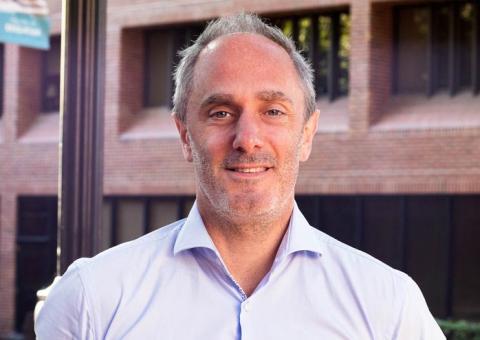
Nigel Newbutt
Assistant Professor
Phone
352-273-4214
Address
PO Box 117048
Gainesville, FL 32611
Connect
About
Dr. Nigel Newbutt is an Assistant Professor of Advanced Learning Technologies and Director of the Emerging Technology Research Lab in the College of Education at the University of Florida. He is an award-winning, internationally recognized leader in the development of emerging technologies that advance access, inclusion, and meaningful participation for autistic and neurodivergent communities.
Dr. Newbutt’s research portfolio focuses on the design, evaluation, and responsible integration of immersive technologies, particularly virtual reality, for autistic groups. He is among the earliest scholars to systematically investigate VR head-mounted displays with autistic users, generating foundational insights that have shaped research, education, and industry practice worldwide. His current work advances the co-design of VR experiences in direct partnership with autistic people, ensuring that tools intended to support daily living, learning, and self-advocacy are informed by community priorities and lived experience. As an expert qualitative and mixed-methods researcher, he applies rigorous, community-informed approaches to capture the nuanced experiences, needs, and priorities of autistic individuals and their families.
Alongside his academic leadership, Nigel has a long-standing commitment to community engagement and social impact. He co-founded a UK-based charity dedicated to supporting autistic youth and their families, and he continues to collaborate closely with nonprofits, advocacy groups, and service organizations to advance equitable opportunities in education, employment, and independent living. His work integrates participatory methods, interdisciplinary innovation, and a deep partnership ethos, setting new standards for inclusive technology design in XR.
Dr. Newbutt’s research portfolio focuses on the design, evaluation, and responsible integration of immersive technologies, particularly virtual reality, for autistic groups. He is among the earliest scholars to systematically investigate VR head-mounted displays with autistic users, generating foundational insights that have shaped research, education, and industry practice worldwide. His current work advances the co-design of VR experiences in direct partnership with autistic people, ensuring that tools intended to support daily living, learning, and self-advocacy are informed by community priorities and lived experience. As an expert qualitative and mixed-methods researcher, he applies rigorous, community-informed approaches to capture the nuanced experiences, needs, and priorities of autistic individuals and their families.
Alongside his academic leadership, Nigel has a long-standing commitment to community engagement and social impact. He co-founded a UK-based charity dedicated to supporting autistic youth and their families, and he continues to collaborate closely with nonprofits, advocacy groups, and service organizations to advance equitable opportunities in education, employment, and independent living. His work integrates participatory methods, interdisciplinary innovation, and a deep partnership ethos, setting new standards for inclusive technology design in XR.
Affiliations
- School of Teaching and Learning
- Institute for Advanced Learning Technologies
Research Interests
Design and Development of Educational Technology Interventions, Educational / Instructional Design, Emerging Technologies, Learning Culture and Technology, Universal Design for Learning, Virtual Reality
Education
- PhD (University College Dublin, 2013). Virtual Reality Technologies for Autistic Groups
- PG Diploma (University of East London, 2011). Research Methods
- MA (University of Greenwich, 2010). Higher Education
- BSc (Leeds Beckett University, 2001). Multimedia Technology
Professional Appointments
- Assistant Professor, School of Teaching and Learning, University of Florida, Gainesville, FL (2021-present)
- Senior Lecturer (Assistant Professor), University of the West of England, Bristol, UK (2015-2021)
- Senior Lecturer, Bath Spa University, Bath, UK (2013-2015)
- Research Manager, SMARTlab, University College Dublin, Ireland (2011-2013)
- Senior Lecturer, University of Greenwich, London, UK (2005-2011)
- Lecturer, University of Greenwich, London, UK (2003-2005)
- Instructional Designer, St George's Hospital Medical School, London, UK (2001-2003)
Activities and Honors
- Editor-in-Chief, Journal of Enabling Technologies (2019-present)
- Evaluation Committee: 8th ACM Celebration of Women in Computing: womENcourage (ACM) (2021)
- Co-Chair for session at HCI International, Washington, US: Enabling Technologies for Marginalized Groups: Removing Barriers and Improving Outcomes (2021)
- Winner: Outstanding Reviewer for Journal of Enabling Technologies (2017)
- Winner: Outstanding Reviewer for Journal of Assistive Technologies (2016)
- Recognized for outstanding achievement as a social entrepreneur, through VIRTAUT research project by HEFCE/UnLtd. Awarded "Outstanding Teaching Staff Social Entrepreneur" (2011)
- Expert Grant Reviewer, Economic and Social Research Council (ESRC) (2017-2021)
Selected Grants
CONNECTED: Creating Opportunities for Neurodiverse Learners in Skilled Technical Environments via Collaborative Virtual Experiences
Role
- PI (UF)
Funding Agency
- NSF
Project Period
- 2024-2027
Award Amount
- $300,000
Preparing Autistic individuals for Transition to become Hardware Security engineers (PATHS)
Role
- Co-PI (UF)
Funding Agency
- NSF
Project Period
- 2024-2027
Award Amount
- $560,000
Advancing Social Inclusion through Technology and EmPowerment (a-STEP).
Role
- Co-PI
Project Period
- 2020-2021
Award Amount
- $500,000
Integrating Social Robots into School Settings: Co-Designing Robot-Enhanced Classrooms for Children with Autism
Role
- PI
Project Period
- 2020-2021
Award Amount
- $33,500
Immersive Virtual Reality as a Tool for Autistic Pupils and Teachers (IVRAP)
Role
- Co-PI
Project Period
- 2019-2022
Award Amount
- $42,000
Virtual Reality Technologies for Autistic Groups: Social Skills Development (VRTAG- SSD
Role
- PI
Project Period
- 2017-2018
Award Amount
- $18,000
MentorMe3D: 3D Immersive Environments to Support Employment Opportunities for Autistic People
Role
- Co-PI
Project Period
- 2016-2017
Award Amount
- $20,000
Virtual Reality Acceptance, Immersion, Ecological Validity, and Negative Effects of Head-Mounted Displays Used by People with Autism: A Pilot Study
Role
- PI
Project Period
- 2014-2016
Award Amount
- $35,000
Selected Publications
- Thomas, R & Newbutt, N. (2025). Using Virtual Reality to Support Autistic Employees: A Perspective on Creating Inclusive Neurodiverse Work Environments. Frontiers in Virtual Reality, section Virtual Reality and Human Behaviour, (7), 1-7. https://doi.org/10.3389/frvir.2025.1648971
- Ma, C+., Haire, G., Smith, S., & Newbutt, N. (2025). Enhancing English as foreign language education with virtual reality and augmented reality in K–12 classrooms: A systematic review from 2019 to 2023. Technology in Language Teaching & Learning, 7 (3). https://doi.org/10.29140/tltl.v7n3.102535
- Cricelli, G., Newbutt, N., Alexander, J., Ellison, C., & Loetscher, T. (2025). Implementation of Virtual Reality for Neurodivergent Individuals: Perspectives of Disability Care Staff. Journal of Enabling Technologies, (19) 2, 128-140. https://doi.org/10.1108/JET-09-2024-0062
- Kuo, H.J., Newbutt, N., George, S. and Laird, M. (2025). Using Virtual Reality Mediation in a Workplace Setting for Employees with Disabilities: A Pilot Study. Computers and Education: XR, 6(1) 1-8. https://doi.org/10.1016/j.cexr.2025.100093
- McCabe, C., Newbutt, N., Hutchinson, A. and Loetscher, T. (2025). Insights into Sensory and Relaxation Preferences to Inform the Design of Sensory Rooms for Autistic Adults. Autism in Adulthood, 1-22. https://doi.org/10.1089/aut.2024.0088
- Newbutt, N and Bradley, R. (2025). Exploring ethical research issues related to extended reality technologies used with autistic populations. Journal of Responsible Technology. (21), 1-8. https://doi.org/10.1016/j.jrt.2024.100102
- Carrington, J.M, Love, R, Bumbach, M.D, Maymi M.A, and Newbutt, N. (2024). Nursing Education and Artificial Intelligence. Studies in Health Technologies and Informatics. (24)315, 165-169. https://doi.org/10.3233/SHTI240127
- Battle, D., Kao, Y+., Newbutt, N. and Crippen, K. (2024). Promoting Inclusive Visits to a Natural History Museum with a Pre-Visit VR Tour for Autistic Families. Research in Science Education, 55(3), 511-528. https://doi.org/10.1007/s11165-024-10207-z
- Pérez-Fuster, P., Herrera, G., Vera, L., López-Fernández, A., López, A., Savaş-Taşkesen, U. and Newbutt, N. (2024). Multisite usability and safety trial of an immersive virtual reality implementation of a work organization system for autistic learners: implications for technology design. Journal of Educational Technology Research and Development, 73(1), 541-565. https://doi.org/10.1007/s11423-024-10422-5
- Schmidt, M., Newbutt, N., Lee, M., Lu., Francois. M., Antonenko. P and Glaser, N. (2023). Towards A Strengths-based Model for Designing Virtual Reality Experiences for Autistic Users. Autism, 28 (7). https://doi.org/10.1177/13623613231208579
- Newbutt, N., Glaser, N., Francois, M., Schmidt, M and Cobb, S. (2023). How are autistic people involved in the design of extended reality technologies? A systematic literature review, Journal of Autism and Developmental Disorders, 54(11), 4232-4258. https://doi.org/10.1007/s10803-023-06130-3
- Lorenzo, G., Newbutt, N., & Lorenzo-Lledó, A. (2023). Designing virtual reality tools for students with Autism Spectrum Disorder: A systematic review. Education and Information Technologies, 28(8), 9557-9605. https://doi.org/10.1007/s10639-022-11545-z
- Newbutt, N., Rice. L., Lemaignan, S., Daly, J., Charisi, V. (2023). Co-designing a social robot in a special educational needs school: Listening to the ambitions of autistic pupils and their teachers. Interaction Studies, 23 (2), 204-242. https://doi.org/10.1075/is.21031.new
- Reece, R., Bornioli, A., Bray, I., Newbutt, N., Satenstein, D. & Alford, C. (2022) Exposure to green, blue and historic environments and mental well-being: A comparison between virtual reality head-mounted display and flat screen exposure. International Journal of Environmental Research and Public Health, 19 (15). 9457-9478. https://doi.org/10.3390/ijerph19159457
- Parsons, T. D., Riva, G., Parsons, S., Mantovani, F., Newbutt, N., Eva, L. L., & Hal. T. (2017). Virtual reality in pediatric psychology. Pediatrics, 140(2), 86-91.
- Newbutt, N., Sung, C., Kuo, H-J., Leahy, M. J., Lin, C-C., & Tong, B. (2016). Brief review: The use of a virtual reality headset in autism populations, a pilot study of technology acceptance and immersion. Journal of Autism and Developmental Disorders, 46(9), 3166-3176.
- Magkafa, D., Newbutt, N., & Palmer, M. (2021). Implementing co-design practices for the development of a museum interface for autistic children. In A. Brooks, S. Brahnam, & L. Jain (Eds.), Recent advances in technologies of inclusive well-being: Virtual patients, gamification and simulation. Springer, USA.
- Robb, N., Politis, Y., Newbutt, N., Doyle, B., Kuo, H-J., & Sung, C. (2021). Participatory technology design for autism and cognitive disabilities: A narrative overview of issues and techniques. In A. Brooks, S. Brahnam, & L. Jain (Eds.), Recent advances in technologies of inclusive well-being: Virtual patients, gamification and simulation. Springer, USA.
- Schmidt, M., Newbutt, N., Schmidt, C., Glasser, N., & Beck. D. (2020). A process-model for minimizing adverse effects when using head mounted display-based virtual reality for individuals with autism2019. Association for Educational Communications and Technology (AECT), Jacksonville, USA.
- Newbutt, N. (2019). Assisting people with Autism Spectrum Disorder through technology. In A. Tatnall (Ed.), Encyclopedia of education and information technologies. Springer, Switzerland.
- Agusita, E., Gillet, M., Palmer, M., & Newbutt, N. (2019). Design hacks: Flips and tips for pedagogic innovation. Centre for Innovation in Higher Education (CIHE) Annual Conference 2019. Anglia Ruskin University, UK.
- Newbutt, N., & Cobb, S. (2018). Towards a framework for implementation of virtual reality technologies in schools for autistic pupils. In P. Standen, S. Cobb, D. Brown, P. Gamito, & K. Appiah (Eds.), 12th International Conference on Disability, Virtual Reality and Associated Technologies in Collaboration with Interactive Technologies and Games (ITAG) (pp. 255-258). University of Nottingham, 4-6 September 2018, Nottingham, UK.
- Magkafa, D., & Newbutt, N. (2018). The process of involving children with autism in the design of a museum-based application. MW18: Museums and the Web 2018, 18-21 April 2018, Vancouver, Canada.
- Newbutt, N., Sung, C., Kuo, H-J., & Leahy, M. J. (2017). The potential of wearable technology (head-mounted displays) and virtual reality to support people with autism: Acceptance, challenges, and future applications. In A. Brooks, S. Brahnam, & L. Jain (Eds.), Recent advances in technologies for inclusive well-being: From worn to off-body sensing, virtual worlds, and games for serious applications (Chapter 11, pp. 221-241). Springer.
Selected Links
- UF's Educational Technology program
- Institute for Advanced Learning Technologies
- Journal of Enabling Technologies
- edia Reports/Link to Dr Newbutt's Research
- https://www.spectrumnews.org/features/deep-dive/virtual-reality-transforming-autism-studies/
- https://www.independent.co.uk/news/science/virtual-reality-may-be-help-autistic-children-classroom-a7676391.html